Trillion-Dollar Digital Healthcare Transformations Shaped by AI, Quantum and Biotech Breakthroughs at GITEX GLOBAL
-
The world's largest tech and AI show
brought groundbreaking innovations in healthcare, neurotech and life sciences
to the forefront
-
M42, Cleveland Clinic, SandboxAQ,
Mammoth Biosciences, Paradromics and Liquid AI steered the conversations on
faster, more effective healthcare discoveries and industry transformation
DUBAI, UAE, Nov.
10, 2025 /PRNewswire/ -- The convergence of AI, quantum computing,
and biosciences is propelling the global healthcare industry into a new era -
now projected to surpass US$1.7 trillion in AI-driven biotech spending by 2025,
according to Nasdaq. At the recently concluded GITEX GLOBAL 2025,
this transformation took centre stage, showcasing how medical breakthroughs
that once took years of research cana now be simulated, modelled, and validated
in mere days through the power of intelligent computing.
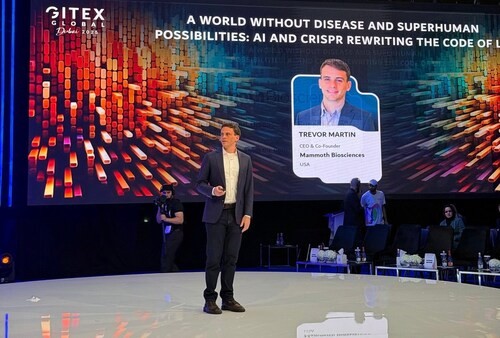
On the main stage,
Trevor Martin, CEO and Co-Founder of Mammoth Biosciences
From 13-17 October
2025, the 45th edition of the world's largest tech and AI show united 6,800
exhibitors, 2,000 startups, and delegations from 180 nations, with digital
health and biotech emerging as some of the most dynamic narratives of the week.
From genome editing to neurotech and quantum medicine, GITEX GLOBAL became
the platform where the world's brightest minds explored how technology is
fundamentally rewriting the science of life.
AI's Healthcare Rise:
From Genetic Code to Neural Connections
On the GITEX main
stage, Trevor Martin, CEO and Co-Founder of Mammoth Biosciences, captured
imaginations with his vision of "rewriting the code of life."
Demonstrating how AI and CRISPR technologies can accelerate gene-editing
therapies, he revealed, "We have programs across liver, muscle,
the brain, where we're actively working on curing genetic diseases using this
method of changing the DNA. We've started with rare diseases, but there's no
reason that we have to stop there. Imagine how many millions of lives this
could save."
Neurotech pioneer,
Matt Angle, CEO of Paradromics, revealed progress from the world's first
successful brain-computer implant and high data brain-computer interface. Matt
noted: "In our clinical trials, we're trying to enable people who can't
speak to speak. We put the device in an area of their motor cortex … and when
you have a high data brain computer interface, you can just try to speak, and
it turns into speech right away."
In "Genomics
Beyond Humans: Unlocking Evolution's Drug Library," Ashley
Zehnder, CEO of Fauna Bio, demonstrated how the study of mammal genomes is
opening an untapped library of new drug discoveries. Ashley explained:
"We're really just hitting the tip of the iceberg in terms of what we can
learn about natural adaptation across the world. Animals like the spiny mouse
that can regenerate many different tissues in the body, spinal cord, brain kidney,
we can learn from these species."
With global
pharmaceutical R&D costs averaging US$2.23 billion per asset as per
Deloitte, innovation in this field has long been limited by time and resources.
At GITEX GLOBAL, Jack Hidary, CEO of SandboxAQ, introduced a
game-changing solution: quantum algorithms capable of compressing research
timelines from decades to months. Jack stated: "A Large
Quantitative Model or LQM is not built on words but on numbers, equations,
molecules and atoms, and trained a different way. We've built a virtual
simulator that lets you test the smallest of particles, so you can test it
millions of times, fast."
The dialogue extended
from lab-scale to system-level reform in a session titled "The $10
Trillion Transition: From Sick Care to Health Intelligence," where
Dimitris Moulavasilis, Group CEO of M42, and Dr. Georges-Pascal Haber, CEO of
Cleveland Clinic, called for a complete system overhaul in how healthcare is
funded and delivered. Dimitris Moulavasilis shared, "Today's
systems are treatment-oriented, hospital-centric and heavily reactive. To build
resilient, sustainable systems, we don't just need more investments towards
prevention, but also need to redesign the system all the way, to try to keep
patients healthy."
Meanwhile, Ramin
Hasani, CEO of Liquid AI, unveiled liquid neural networks - architectures
inspired by the brains of microscopic worms - capable of learning and adapting
in real time, mirroring the flexibility of living intelligence.
Headline-Making
Innovations Accelerating Global Healthcare & Biosciences
The breakthroughs
unveiled at GITEX GLOBAL 2025 set a new benchmark for how technology, biology
and wellness converge into scalable solutions for real-world impact.
XPANCEO captivated
audiences with six smart contact-lens prototypes, integrating augmented reality
and biosensing to monitor glucose levels and overlay real-time data in the
wearer's field of view — a bold step toward wearable, always-on medical
computing.
SharedPro
Technologies
unveiled an AI-powered behavioural analysis tool
designed to bring greater precision to autism screening and tracking
developmental progress; a breakthrough in a field that continues to face gaps
in scientific understanding and diagnostic consistency. Meanwhile, South Korean
startup HurayPositive introduced its AI-powered SaaS enabling
precision medicine for one million patients with chronic conditions.
Arlan Biotech debuted a
GenAI-driven discovery platform that reimagines how antibodies are designed and
developed, which could drastically shorten the pharmaceutical R&D cycle and
accelerate breakthroughs in precision immunotherapy.
Sonic Group showcased the
Sonic Pill®, a breakthrough in sound-based wellness technology that uses
precision audio frequencies and neuroscience-driven algorithms to enhance
sleep, focus, recovery, and cognitive performance. Winner of 'The Best
Invention' FIRI Award in Korea and Silver Medal for Sound Therapy Innovation at
ARCA Croatia, the wearable device redefines how sound can be harnessed to
elevate human health and wellbeing.